
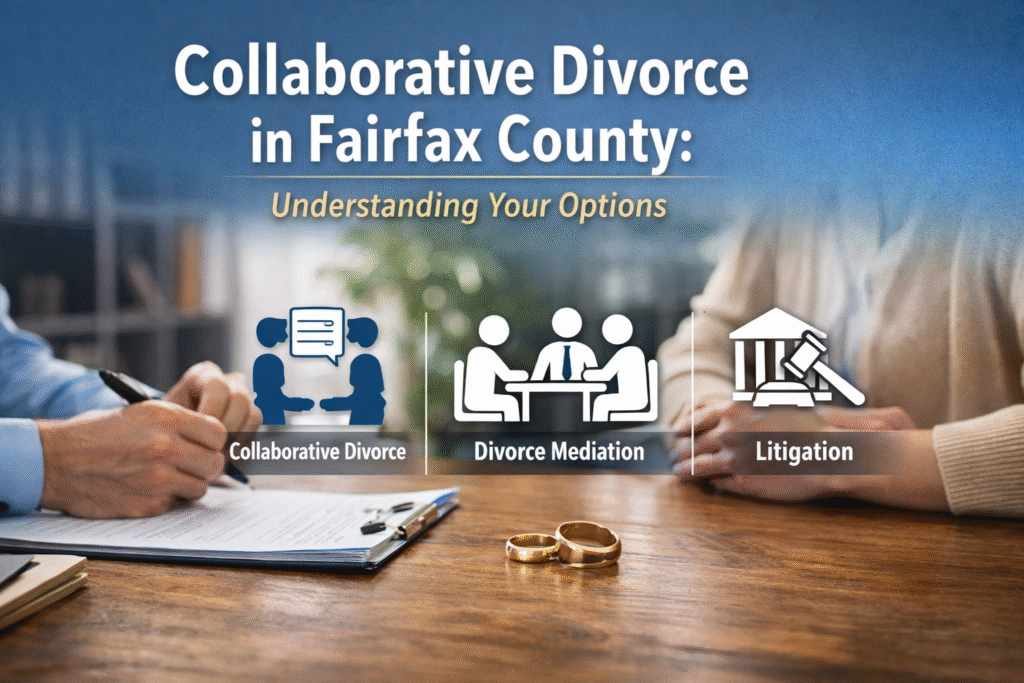
When couples in Fairfax County consider divorce, they often want to understand their options before moving forward. While litigation through the court system remains available, many families explore private, out-of-court approaches such as divorce mediation or collaborative divorce.
Understanding how these processes differ can help you choose the approach that best fits your family’s needs, priorities, and level of conflict.
Divorce Mediation
Divorce mediation is a voluntary, confidential process in which a neutral mediator helps spouses negotiate and resolve the issues in their divorce. It works best for families with low to moderate conflict, where spouses can communicate productively and make decisions together with the mediator’s help.
In mediation:
• Spouses meet together with a neutral mediator.
• The mediator guides discussions regarding property division, support, and parenting.
• Parenting plans are developed directly in mediation sessions.
• Each spouse may consult with their own attorney outside the mediation sessions; attorneys represent their clients but do not attend the meetings.
• The parties retain full decision-making authority.
Mediation allows couples to maintain control over their outcomes rather than having decisions imposed by a judge. It is efficient, private, and cost-conscious. For many families in Fairfax County, mediation provides a balanced and practical path forward while still allowing access to independent legal advice.
Collaborative Divorce
Collaborative divorce is a private, out-of-court process best for families with moderate conflict, where structured support from professionals helps manage communication and negotiation. Each spouse retains a collaboratively trained attorney who participates in negotiations, and the parties sign an agreement committing to resolve issues without going to court.
In collaborative divorce:
• Each spouse has an attorney involved in the negotiation process; attorneys represent their clients and are not neutral.
• Neutral professionals may be included, such as a financial specialist or a divorce coach.
• When a coach is involved, parenting meetings are conducted with the coach, typically without attorneys present.
• All participants commit to transparency and respectful negotiation.
• If the process does not succeed, the collaborative attorneys must withdraw before litigation begins.
Collaborative divorce can be appropriate for families who want ongoing attorney participation while also benefiting from professional support for communication and parenting discussions.
Litigation
Litigation is the traditional court-based divorce process, appropriate for families experiencing high conflict or situations where court intervention is required. Each party hires an attorney to advocate on their behalf, and a judge ultimately makes decisions if the parties cannot reach agreement.
Litigation:
• Is public and court-driven.
• Follows formal procedural rules and deadlines.
• May involve hearings, motions, and trial.
• Places final decision-making authority with the judge.
While litigation is sometimes necessary, many families consider mediation or collaborative divorce first in order to maintain privacy and greater control over outcomes.
Comparison of Divorce Processes in Fairfax County
| Feature | Mediation | Collaborative Divorce | Litigation |
|---|---|---|---|
| Neutral professional involved | Yes (mediator) | Yes (financial specialist and/or coach; attorneys are not neutral) | No neutral facilitator |
| Attorneys present at meetings | No; attorneys represent clients but consult outside sessions | Yes; attorneys represent clients | Yes |
| Parenting discussions | Conducted in mediation sessions | Facilitated by a coach, typically without attorneys present | Through attorneys, court procedures, or custody evaluation |
| Decision-making authority | The spouses | The spouses | Judge if no agreement |
| Privacy level | Private and confidential | Private and confidential | Public court process |
| Court involvement | Minimal until final filing | Minimal until final filing | Extensive |
| Appropriate conflict level | Low to moderate | Moderate | High |
Choosing the Right Approach in Fairfax County
Every family’s circumstances are unique. Divorce mediation offers a flexible and efficient path to resolution while keeping decision-making in the hands of the parties. Collaborative divorce provides attorney participation within a private negotiation setting and may include additional professional support when communication challenges exist. Litigation remains available when court intervention is required.
Learning about these approaches allows you to make an informed decision about how you want to move forward.
Ready to explore your options? Contact Kales & Kales, PLC to learn more about how mediation or collaborative divorce can work for your family.