
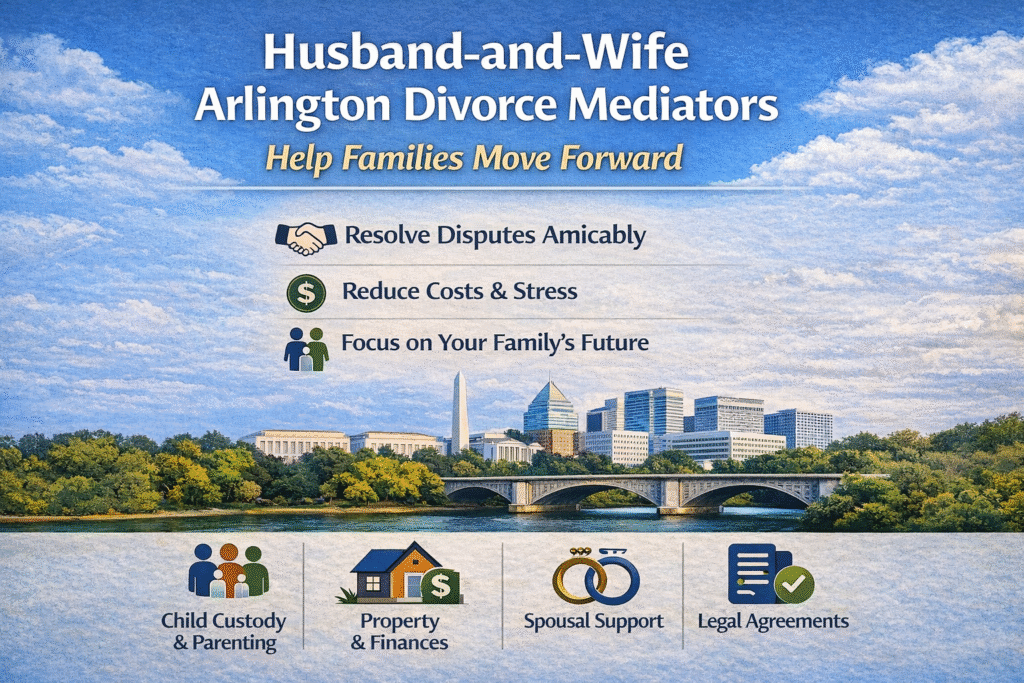
Divorce is one of life’s most challenging experiences, both emotionally and financially. In Arlington, Virginia — a vibrant, family‑oriented community in the heart of Northern Virginia — couples increasingly seek amicable, efficient, and cost‑sensitive alternatives to traditional litigation. At the forefront of this movement are husband‑and‑wife co‑mediators, Jonathan and Amy Kales, whose collaborative and compassionate divorce mediation services help families resolve disputes peacefully, preserve relationships, and control their future.
Whether you’re searching for “divorce mediators near Arlington, VA”, “Arlington divorce mediation”, or “co‑mediation divorce services Northern Virginia,” this article explains why mediation with Jonathan and Amy Kales could be the right path for your unique situation — and how it works step‑by‑step.
Why Divorce Mediation in Arlington Is a Better Choice for Many Couples
Before diving into the specifics of the Kales approach, it’s important to understand why mediation is increasingly preferred over traditional divorce litigation:
1. Mediation Keeps You in Control
Unlike courtroom litigation, where a judge makes decisions, mediation enables both spouses to negotiate and agree on terms like property division, child custody and support, and spousal support. This personalized approach helps ensure outcomes better aligned with your family’s goals rather than a one‑size‑fits‑all court order.
2. Significantly Lower Costs
Divorce can be expensive. In traditional litigation, couples often pay tens of thousands in legal fees, court costs, and hours tied up in motions and hearings. In contrast, mediation is structured to be far more cost‑effective, usually concluding in just a few sessions with a transparent fee framework.
3. Faster and More Efficient Resolution
Court calendars are crowded and procedural requirements can drag divorce cases out for months or even years. Mediation eliminates many of these delays by focusing on constructive negotiation, flexibility, and scheduling that works for you.
4. Better for Families & Children
Because mediation encourages respectful communication and joint problem‑solving, families often exit the process with stronger communication skills and healthier co‑parenting potential — a crucial benefit when children are involved.
Meet Jonathan & Amy — Arlington’s Husband‑and‑Wife Co‑Mediation Team
Who Are the Kales?
At the heart of these mediation services is a trusted and experienced co‑mediator team:
-
Jonathan L. Kales — A Virginia Supreme Court‑certified family law mediator since 2005, Jonathan has decades of experience helping couples find constructive resolutions to their family law matters.
-
Amy Grillo Kales — An equally skilled mediator and family law attorney, Amy brings deep insight into the collaborative process and a personal commitment to helping families find peace.
As a husband‑and‑wife team, they bring complementary strengths, perspectives, and empathy to every case they mediate, while maintaining strict neutrality. Unlike typical mediation models with a single facilitator, their co‑mediation approach offers advantages that can make mediation more effective and balanced for both parties.
The Unique Advantage of Co‑Mediation
Gender Balance & Neutrality
One of the most compelling benefits of co‑mediation is gender balance. Because Jonathan and Amy are a male‑female team, each spouse often feels equally seen and supported in the room — regardless of gender dynamics. This can help reduce perceptions of bias and build trust in the mediation process.
Two Sets of Eyes, One Goal
With two mediators present, there’s increased attention to detail, clarity in communication, and availability of perspectives as discussions unfold. One mediator can facilitate while the other listens deeply and captures nuances — making the process smoother and more thorough.
Enhanced Efficiency
Co‑mediation often accelerates progress because both facilitators can share roles within a session: one may lead a discussion while the other takes note or organizes follow‑up tasks. This collaborative approach helps reduce the number of sessions needed, saving time and cost.
What Issues Can Be Resolved Through Mediation?
Divorce mediation with the Kales team isn’t limited to a narrow set of topics. Instead, couples are guided through every major decision point in a Virginia divorce:
Children & Parenting
-
Custody and visitation schedules
-
Shared parenting plans
-
Child support and related financial planning
Financial Matters
-
Division of marital property
-
Allocation of debt
-
Spousal support / alimony
-
Retirement, investments, and real estate
Legal Documentation
Once terms are agreed upon in mediation, the Kales team drafts a legally sound Marital Settlement Agreement that can be filed with the court to finalize the divorce.
This comprehensive coverage ensures that all issues are addressed in a constructive, organized, and future‑focused way.
How Divorce Mediation Works — Step by Step
Mediation might seem abstract if you’ve never experienced it before. Here’s a breakdown of what to expect:
1. Initial Consultation
Jonathan and Amy begin by understanding your family’s situation, goals, and concerns. They explain the mediation process, how mediation differs from litigation, and how co‑mediation works.
2. Agreement to Mediate
Before substantive discussions begin, both spouses sign an Agreement to Mediate, which outlines the terms, confidentiality, and mediation protocols.
3. Mediation Sessions Begin
Sessions are scheduled at the Arlington office or virtually via Zoom, depending on your needs. Each session typically lasts two to three hours and focuses on one set of issues at a time.
4. Negotiation & Problem Solving
In a calm and structured environment, both spouses share needs, concerns, and options — with Jonathan and Amy guiding the conversation toward mutually agreeable solutions.
5. Written Settlement Agreement
Once terms are agreed upon, the Kales team prepares a Marital Settlement Agreement that reflects these decisions in a legally acceptable format for the Arlington court.
6. Court Filing
After review (and optional, but recommended, attorney consultation), the settlement document is signed. Then, provided the parties have fulfilled the required separation period (6 months with no minor children and 1 year with minor children) and a few preliminary steps with the court, the signed settlement document is submitted to the court with a Final Order of Divorce for approval, concluding the divorce.
This structured yet flexible process lets couples resolve disputes without the stress and uncertainty of litigation.
Costs & Timeframe — Transparency You Can Plan Around
Unlike litigation, which often comes with unpredictable legal fees and procedural delays, divorce mediation with the Kales team offers clear cost expectations.
-
Mediation fees are billed on an hourly basis and usually shared by both parties.
-
Typical cases with children require 2–3 sessions; cases without children often complete in 1–2 sessions.
-
Once agreements are reached, drafting and delivering your settlement usually takes 2-3 weeks.
Because each mediation is unique, the exact total depends on factors like complexity, financial disclosures, and how quickly agreements are reached. But compared to the high expense of litigation, mediation in Arlington often costs significantly less, giving couples a high‑value solution that puts dollars back into their family’s future.
Is Mediation Right for You?
Divorce mediation is ideal for couples who:
-
Are willing to negotiate cooperatively
-
Want to avoid the trauma and expense of court
-
Wish to shape their own outcomes rather than relinquish decisions to a judge
-
Desire privacy, dignity, and mutual respect during the process
However, mediation is not appropriate in cases with domestic violence, untreated substance abuse, financial concealment, or an inability to negotiate in good faith. In such instances, other dispute resolution paths may be better suited.
Real Voices — What Clients Are Saying
Local clients in Northern Virginia consistently highlight the thoughtfulness, clarity, and fairness the Kales co‑mediators bring to difficult conversations. Testimonials praise their ability to keep discussions grounded, make complex decisions manageable, and guide both spouses toward outcomes that feel equitable — even in emotionally charged circumstances.
Frequently Asked Questions (FAQ)
Do I Need an Attorney if I’m Meditating?
No — mediation does not require each spouse to have an attorney on the spot. However, it can be beneficial for each party to consult independent counsel to review the final settlement before signing.
Is Mediation Confidential?
Yes — divorce mediation is generally private and confidential, protecting sensitive information and allowing candid offers without fear of public exposure.
Will We Still Go to Court?
Only the final approval of your agreement goes through the court. You will not be required to stand before a judge unless you choose another path after mediation.
What If We Don’t Agree on Everything?
Mediation can still be helpful in narrowing the issues. Any unresolved topics can be addressed through other legal methods afterward.
Serving Arlington and All of Northern Virginia
In addition to Arlington, Jonathan and Amy welcome clients throughout Northern Virginia — including Fairfax, Falls Church, McLean, Vienna, and surrounding communities — with flexible in‑person or virtual mediation sessions tailored to your schedule.
Start Your Divorce Mediation Journey Today
If you and your spouse want a dignified, affordable, and collaborative divorce solution in Arlington, VA, mediation with Jonathan and Amy Kales might be the right choice. Their shared commitment to neutrality, deep local experience, and co‑mediated model ensures couples are heard, respected, and guided toward practical, long‑lasting agreements.
👉 Looking for trusted Arlington, VA divorce mediation services? Connect with a dedicated team ready to help families move forward with confidence and schedule your consultation today.