
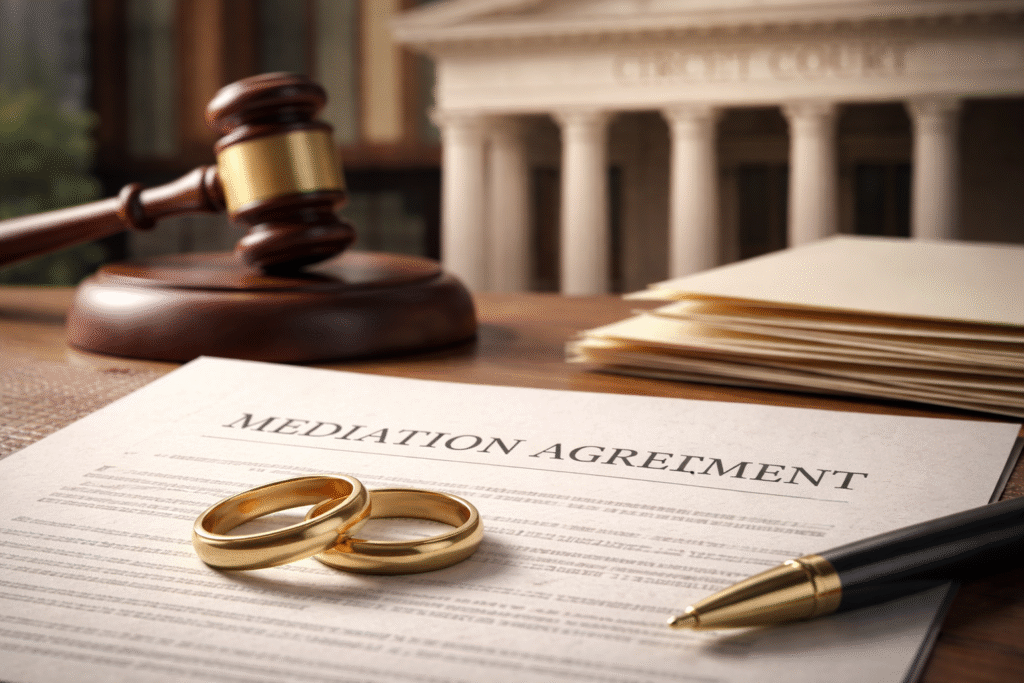
When couples begin searching for Fairfax County divorce mediation, they are often looking for a way to resolve their divorce without the expense, stress, and uncertainty of full-scale litigation. In Fairfax County, mediation can play a meaningful role in helping spouses reach agreement before their case is finalized through the Circuit Court.
This article explains how divorce mediation works in Fairfax County, how it interacts with the Fairfax County Circuit Court, and why mediation is often used as part of an uncontested divorce process.
What Fairfax County Divorce Mediation Means in Practice
Divorce mediation is a structured process in which spouses work with a neutral mediator to resolve issues arising from divorce. Rather than asking a judge to decide contested matters, mediation allows the parties to negotiate terms together.
In Fairfax County divorce mediation, couples commonly address:
- Division of marital assets and debts
- Spousal support
- Child custody and parenting schedules
- Child support
Mediation does not replace the court’s authority to grant a divorce, but it can significantly limit the issues that must be decided by the court and often leads to faster resolution.
The Role of the Fairfax County Circuit Court in a Mediated Divorce
All divorces in Fairfax County are finalized through the Fairfax County Circuit Court. The court has jurisdiction over domestic relations matters, including divorce proceedings.
You can find information about divorce procedures directly on the Circuit Court’s website: 👉 View official divorce information at the Fairfax County Circuit Court Civil Case Information page.
When mediation is successful, the court’s role often includes:
- Reviewing filed paperwork
- Accepting a written settlement agreement
- Entering a final divorce decree
Judges usually incorporate mediated agreements into final orders so long as they meet Virginia’s legal requirements.
How Fairfax County Divorce Mediation Fits into the Legal Process
A typical Fairfax County divorce mediation process may look like this:
Step 1: Mediation Sessions
Spouses meet with a mediator to discuss and resolve disputed issues.
Step 2: Written Settlement Agreement
Once terms are agreed upon, they are reduced to a written settlement agreement suitable for court submission.
Step 3: Filing with the Fairfax County Circuit Court
The agreement is filed as part of an uncontested divorce or incorporated into an existing case.
Step 4: Court Approval and Final Decree
If the agreement complies with Virginia law, the circuit court will incorporate it into the final divorce decree without contested hearings.
This process often shortens timelines and reduces procedural complexity.
Why Many Couples Choose Fairfax County Divorce Mediation
Couples who pursue mediation in Fairfax County often do so because it offers:
- Greater predictability, compared to leaving decisions entirely to a judge
- Privacy, since mediation discussions are confidential
- Flexibility, allowing customized solutions not always available in court
- Efficiency, particularly in uncontested divorce cases
For parents, mediation can also help establish cooperative frameworks that extend beyond the divorce itself.
Situations Where Mediation May Be Limited
While Fairfax County divorce mediation works well for many couples, it may not be appropriate in all cases. Circumstances such as significant power imbalances, unresolved safety concerns, or lack of willingness to negotiate in good faith may require a more traditional court-assisted approach.
Understanding whether mediation is appropriate depends on individual facts and how they intersect with Virginia law and court procedures.
Fairfax County Divorce Mediation and Court-Ready Agreements
One important consideration in mediation is ensuring that agreements are court-ready — meaning they are drafted with an understanding of how the Fairfax County Circuit Court reviews settlement terms.
Agreements reached in mediation should:
- Be clear and complete
- Address all required legal issues
- Comply with Virginia statutes and court standards
This is especially important when agreements involve children or long-term financial obligations.
A Practical Resource: Virginia Court Mediation Information
Although the Fairfax County Circuit Court handles divorce filings, mediation in Virginia is recognized as a voluntary and confidential alternative dispute resolution process. The Virginia Courts Mediation page provides general information about mediation principles and the role of certified mediators.
You can also access the Virginia Court System’s Searchable Mediator Directory to identify certified mediators available in the Northern Virginia area.
Considering Fairfax County Divorce Mediation?
If Fairfax County divorce mediation is something you are considering — whether to limit court appearances, reduce conflict, or reach a more tailored outcome — the attorney mediators at Kales & Kales can help you understand how these options align with your situation and Virginia law.
With Jonathan Kales serving as a Virginia Supreme Court–certified mediator, clients have access to mediation services informed by both legal experience and formal ADR certification.
Explore additional family law and mediation insights at kaleslaw.com, including resources on divorce procedures, settlement agreements, and preparing court-ready agreements for the Fairfax County Circuit Court.
This content is provided for general informational purposes and is not legal advice. Court procedures and outcomes vary based on individual facts and circumstances.