


Kales & Kales provides divorce mediation services in Fairfax, Arlington, and Tysons Corner. Jonathan Kales, Virginia Supreme Court Certified Family Mediator since 2005, and Amy Kales work as a co-mediation team to help couples reach collaborative divorce agreements and avoid court. Call (703) 896-7580 to schedule an educational consultation.
By Jonathan L. Kales, Esq.
Virginia Supreme Court Certified Family Mediator Since 2005
⚡ TL;DR: Divorce Mediation in Northern Virginia
What it is: A voluntary, collaborative process where a Virginia Supreme Court Certified mediator helps couples reach divorce agreements without court litigation.
Cost: $3,500-$7,000 total (split between spouses) vs. $25,000-$100,000 per spouse in litigation
Timeline: 2-3 sessions over 6-8 weeks vs. 12-24 months for contested divorce
Best for: Couples with moderate conflict (5/10 or lower), willingness to compromise, no domestic violence or hidden assets
Divorce Mediation in Northern Virginia
Divorce mediation offers Northern Virginia couples a collaborative alternative to contested litigation in Fairfax County Circuit Court. Unlike adversarial divorce proceedings that often take 12-24 months and cost $25,000-$100,000 per spouse, mediation typically concludes in 6-8 weeks at a fraction of the cost. Virginia Supreme Court Certified mediators facilitate settlement discussions on custody, support, property division, and other divorce issues while couples maintain control over outcomes and preserve co-parenting relationships.
Why Choose Virginia Supreme Court Certified Mediators?
At Kales & Kales, our goal as Virginia family law mediators is to provide a safe environment in which we—the co-mediation team of Jonathan and Amy Kales—help couples settle divorce issues and stay out of the Fairfax County Circuit Court system.
In doing so, we guide clients through the complexities of:
- Child custody and visitation
- Child support
- Spousal support
- Property division
- Debt allocation
- Other matters governed by Virginia divorce law
Jonathan Kales has been a Virginia Supreme Court Certified Family Mediator since 2005 and is a member of the Virginia State Bar and the Collaborative Professionals of Northern Virginia (CPNV). Under Virginia Code § 20-107.3 and § 20-108.1, divorcing couples must resolve issues of equitable distribution and spousal support. Our mediation process helps couples address these requirements while maintaining control over their outcomes rather than having a judge impose decisions.
We offer Northern Virginia divorce mediation services either online via Zoom or in-person at our offices in Fairfax, Arlington, and Tysons Corner. Jonathan and Amy Kales have been named Top Lawyers by Northern Virginia Magazine for their work as divorce mediators, and Jonathan was named to Virginia Business Magazine’s 2025 Legal Elite as a top Virginia divorce mediator.
| Question | Answer |
|---|---|
| What is divorce mediation? | A voluntary process where a neutral, Virginia Supreme Court Certified mediator helps couples reach a mutual divorce settlement agreement, avoiding court litigation. |
| How much does mediation cost? | Average $3,500-$7,000 total (split equally), compared to litigation which costs each spouse $25,000-$100,000. No retainer required until settlement drafting. |
| How long does mediation take? | Most couples complete the process in 6-8 weeks with 2-3 sessions. Settlement agreement drafted in 2-3 weeks. |
| Do I need a lawyer? | Recommended but not required. Independent attorneys advise between sessions and review final agreement. Mediator provides legal information but not advice. |
| Is mediation right for me? | Works best when conflict level is moderate (5/10 or lower), both spouses willing to compromise, and no history of domestic violence or hidden assets. |
What is Divorce Mediation in Virginia?
✓ Quick Answer: Divorce mediation is a voluntary, collaborative process where a neutral Virginia Supreme Court Certified mediator facilitates settlement discussions to help couples reach agreements on custody, support, property division, and other divorce issues—without going to court.
Divorce mediation is a voluntary, collaborative process in which a neutral, Virginia Supreme Court Certified mediator helps divorcing couples reach a mutual settlement agreement on all divorce-related issues, including child custody and visitation, child support, spousal support, property division, and debt allocation.
In Virginia, a divorce mediator facilitates settlement discussions but remains neutral and does not provide legal advice or advocate for either spouse. The mediator guides couples through Virginia divorce law requirements under the Virginia Code, including equitable distribution (Va. Code § 20-107.3) and spousal support (Va. Code § 20-108.1), helping them develop and evaluate options for each issue.
Key Differences from Litigation:
- Control: You decide the outcome vs. judge imposes decisions
- Privacy: Confidential process vs. public court proceedings
- Cost: Substantially lower than litigation
- Timeline: Weeks instead of months or years
- Relationships: Preserved co-parenting vs. adversarial damage
Unlike litigation, where a Fairfax County Circuit Court judge imposes decisions after lengthy court proceedings, mediation allows couples to maintain control over their outcomes and reach creative solutions tailored to their family’s unique needs. The mediation process typically results in a Marital Settlement Agreement, which paves the way for a simple, uncontested divorce in Virginia.
Mediation works best in cases where the conflict level, compared to other divorces, is a 5 or lower on a scale of 1 to 10. In higher-conflict cases, another form of alternative dispute resolution—collaborative divorce—is often a better option.
How Much Does Divorce Mediation Cost in Northern Virginia?
✓ Quick Answer: Kales & Kales charges $425/hour for co-mediation with no upfront retainer. Most couples spend $3,500-$7,000 total (split between spouses) compared to litigation costs of $25,000-$100,000 per spouse.
At Kales & Kales, you benefit from a co-mediation team—both Jonathan Kales (Virginia Supreme Court Certified since 2005) and Amy Kales work together for the same $425/hour rate, essentially providing two attorneys for the price of one.
No Upfront Retainer Required: You pay for services at the end of each mediation session. Only when it’s time to draft your written Marital Settlement Agreement will you be asked for a deposit, typically $2,000-$3,000.
Fee Allocation: Spouses typically share mediation fees equally (50/50), paid from current income or marital funds. However, when there’s significant income disparity, fees are sometimes split proportionally (e.g., 70/30 or 60/40) based on each spouse’s income level.
| Factor | Mediation (Kales & Kales) | Litigation |
|---|---|---|
| Hourly Rate | $425/hour (co-mediation team) | $400-$600/hour per attorney |
| Upfront Retainer | $0 (pay per session until settlement drafting) | $7,500-$15,000+ per spouse |
| Total Average Cost | $3,500-$7,000 (split between spouses) | $25,000-$100,000 per spouse |
| Timeline | 2-3 sessions over 6-8 weeks | 12-24 months of depositions, hearings, trial |
| Emotional Cost | Lower conflict, preserved co-parenting | High stress, adversarial, damages relationships |
Mediation vs. Litigation: Financial Comparison
Cost Breakdown Comparison:
| Mediation (2-3 sessions @ $425/hr × 6 hours avg) | $2,550 |
| Settlement agreement drafting ($2,000-$3,000 deposit) | $2,500 |
| Total Mediation Cost | $5,050 |
| Litigation retainer (per spouse) | $10,000 |
| Discovery, depositions, hearings (12-24 months) | $40,000 |
| Total Litigation Cost (per spouse) | $50,000 |
| Net Savings with Mediation | $94,950 |
This is in stark contrast to divorce litigation in Fairfax County, where costs spiral quickly. Northern Virginia divorce attorneys commonly require retainers of $7,500 or more, and total litigation expenditures per spouse often range from $25,000 to $100,000. Emotionally, divorce litigation is stressful, depressing, and exhausting, frequently draining any goodwill that remains between divorcing spouses and making co-parenting extremely challenging.
How Long Does Divorce Mediation Take?
✓ Quick Answer: Most couples complete mediation in 2-3 sessions (2-3 hours each) over 6-8 weeks, plus 2-3 weeks for settlement agreement drafting. This compares to 12-24 months for litigated divorces in Fairfax County.
On average, divorce mediation with Kales & Kales involves 1 to 2 sessions (2-3 hours each) if you don’t have minor children, and 2 to 3 sessions if you do. Most couples complete the mediation process in 6 to 8 weeks, compared to 12-24 months for litigated divorces in Fairfax County Circuit Court.
Factors Affecting Timeline:
- Complexity: High-asset cases, business ownership, or complex custody arrangements may require additional sessions
- Emotional readiness: Couples further along in processing the divorce emotionally often reach agreements faster
- Willingness to compromise: Flexibility and good-faith negotiation speed the process
- Preparation: Organized financial documents and clear priorities reduce session time
Once you reach an agreement in principle, we typically forward you a complete Marital Settlement Agreement within 2 to 3 weeks. This agreement is then submitted to the Fairfax County Circuit Court as part of your uncontested divorce filing.
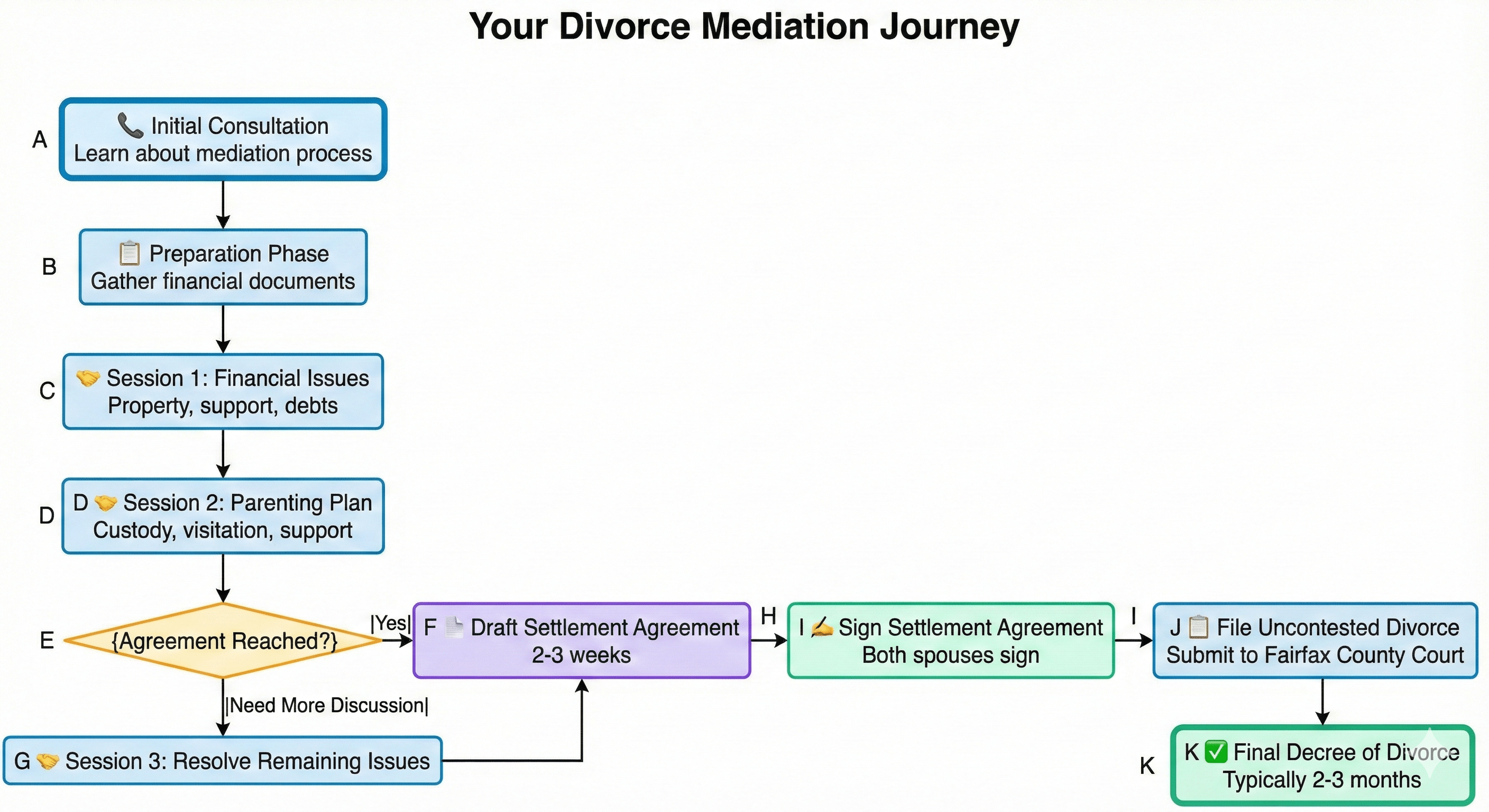
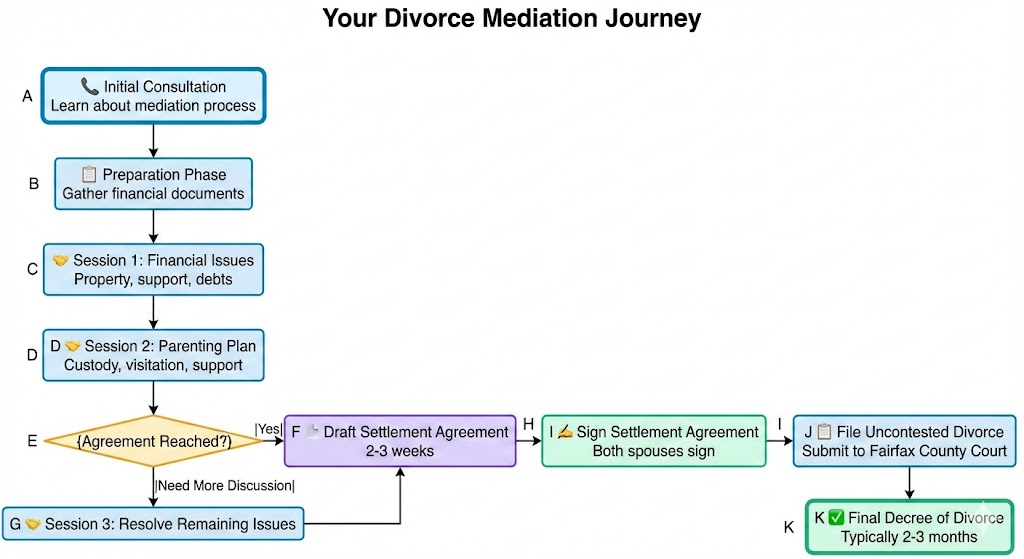
Average Timeline: Most couples complete mediation in 6-8 weeks (2-3 sessions), plus 2-3 weeks for settlement drafting, plus 2-3 months for uncontested divorce finalization = 4-5 months total from start to Final Decree.
Compare to Litigation: Contested divorce in Fairfax County typically takes 12-24 months of depositions, hearings, and court appearances.
The Co-Mediation Advantage: Jonathan & Amy Kales
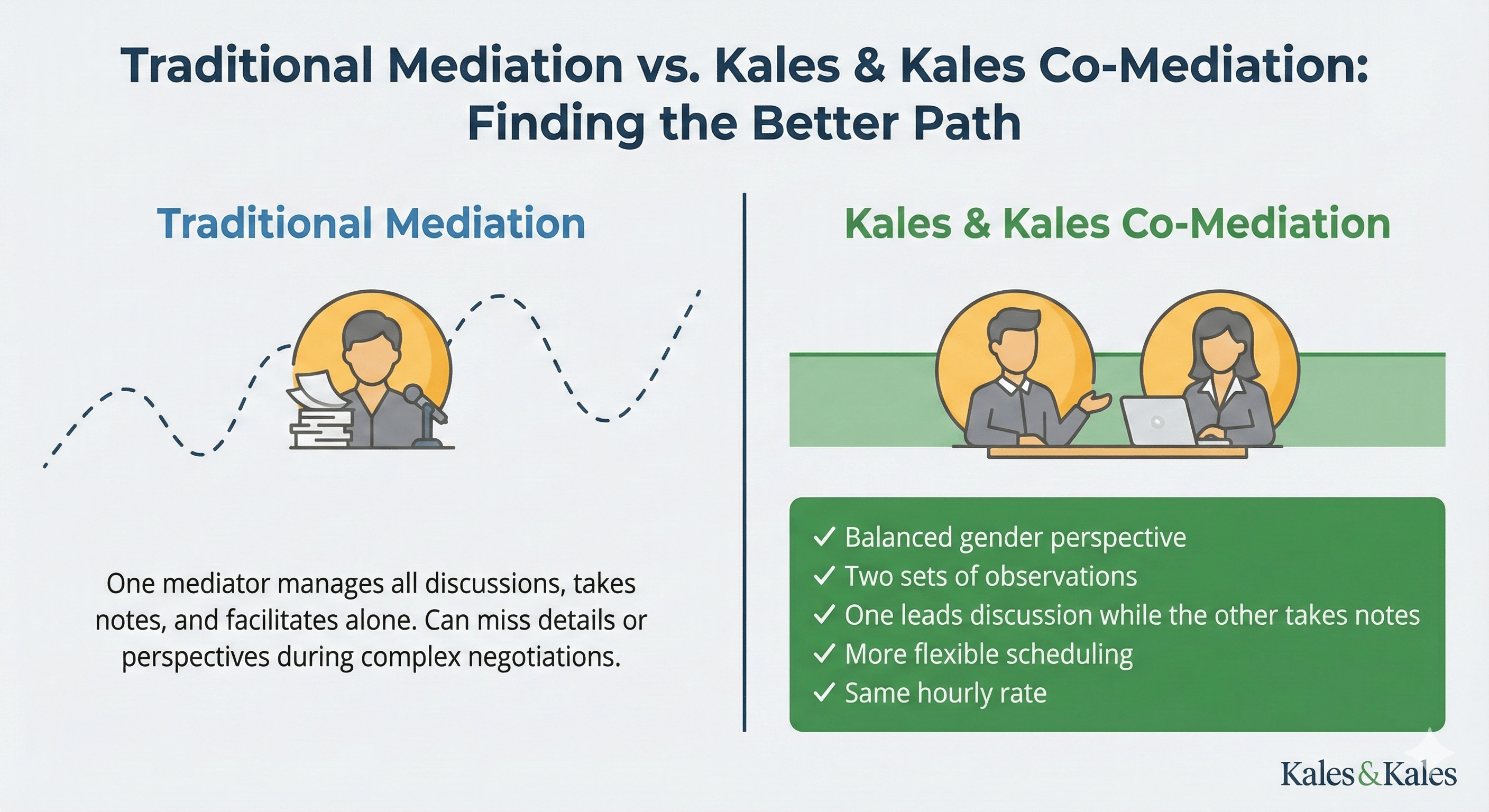
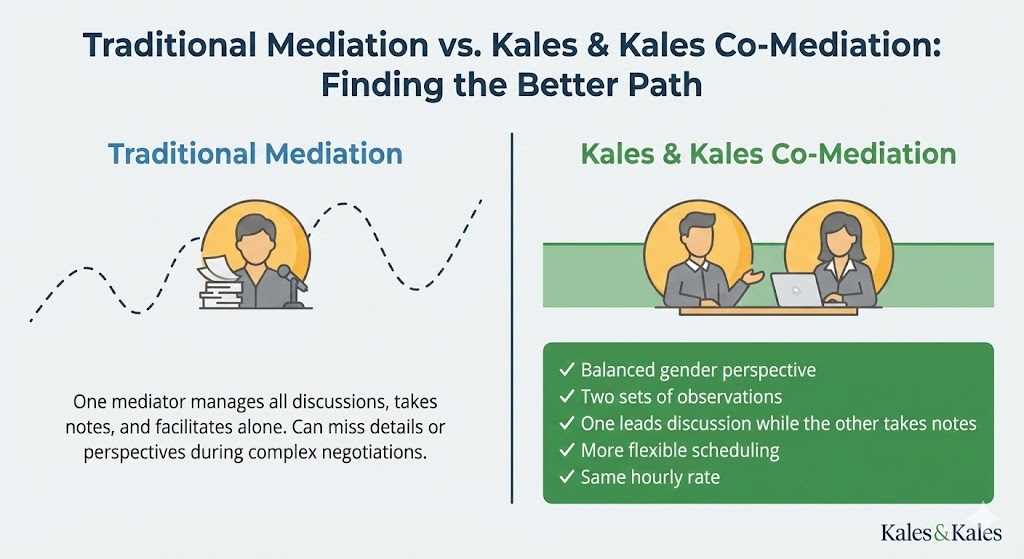
At Kales & Kales, we use a co-mediation model—two mediators working together to facilitate your divorce settlement discussions. Jonathan Kales (Virginia Supreme Court Certified Family Mediator since 2005) and Amy Kales serve as your mediation team, providing multiple perspectives and enhanced process efficiency.
Benefits of Co-Mediation
Gender Balance: With one male mediator (Jonathan) and one female mediator (Amy), neither spouse feels the other has a gender-based advantage. Each spouse has a mediator of their same gender present, which can help foster trust and balance in the mediation process.
Increased Efficiency: Two mediators can speed the process—one takes notes while the other leads discussion, and scheduling is more flexible with two attorneys available to draft agreements. This efficiency often translates to fewer total sessions and lower costs.
Two for the Price of One: Unlike other co-mediation services that charge double, Kales & Kales charges $425/hour total for both mediators—approximately the same rate either attorney charges individually when representing clients in other family law matters. Combined with efficiency gains, this often results in lower total costs than hiring a solo mediator.
Different Perspectives: It’s challenging for one mediator to observe everything during sessions. With two mediators, fewer details are missed, and spouses benefit from multiple viewpoints on complex issues. This dual perspective helps identify creative solutions that might not emerge with a single mediator.
Communication Modeling: By observing Jonathan and Amy work together professionally, couples learn improved communication techniques they can apply to their own negotiations and future co-parenting relationship. This modeling provides a template for respectful, productive dialogue.
Benefits of Divorce Mediation in Virginia
Child-Friendly Process
Research consistently shows the biggest indicator of how well children handle divorce is their parents’ conflict level. When divorcing parents have high conflict, children experience:
- Emotional distress and behavioral issues
- Difficulty adjusting to family changes
- Anxiety about taking sides or testifying
- Long-term relationship challenges
Litigation often escalates conflict, especially when children are interviewed by attorneys, deposed, or required to testify in Fairfax County Circuit Court.
In contrast, Virginia divorce mediation helps parents keep emotions in check and communicate more productively. This shields children from conflict, leads to parenting plans truly in the children’s best interests, and establishes a foundation for effective co-parenting after divorce.
Private and Confidential
Unlike divorce litigation, which occurs in open court with public records, Virginia divorce mediation is a private process. Key confidentiality protections:
- Mediation takes place behind closed doors in the mediator’s office
- Pursuant to Virginia family law, with certain exceptions, all communications made in or in connection with divorce mediation are confidential
- Financial disclosures and settlement discussions remain private
- Children are never involved in mediation sessions
This private, safe environment encourages spouses to be open and honest, ensuring all options can be safely discussed and most often leading to quicker, smoother settlement.
Control Over Outcomes
In mediation, you control the outcome instead of a Fairfax County judge determining your fate. The mediator:
- Facilitates settlement discussions
- Ensures each spouse is heard
- Answers questions about Virginia divorce law
- Helps resolve all required divorce issues plus any additional matters important to your family
Unless mediation begins after litigation has already started, you also control the pace of negotiations without worrying about discovery deadlines, scheduled depositions, and court dates.
Creative Solutions
Divorce mediation allows couples to explore creative options independent of strict legal parameters, increasing the odds of reaching mutually satisfactory agreements.
For example, in litigated divorce in Fairfax County, when spouses own a home together and one cannot afford to buy out the other’s equity, the judge has one option: order the house sold immediately.
In mediation, you’re not nearly as constrained. You can agree to:
- Both spouses stay on title/mortgage temporarily after divorce
- Delay equity buyout or sale until a future date
- Exchange house equity for other assets
- Create custom payment plans or refinancing arrangements
These solutions better fit your family’s unique needs and are unavailable in traditional litigation.
Cost Savings
The financial benefits extend beyond the direct fee comparison. The savings include:
- Reduced stress and anxiety
- Preserved relationships and dignity
- Faster resolution and closure
- More resources available for children’s needs
Faster Resolution
The mediation process almost always resolves faster than litigated divorce:
- Mediation: 2-3 sessions over 6-8 weeks + 2-3 weeks for settlement drafting = 2-3 months total
- Litigation: 12-24 months of formal discovery, depositions, hearings, and potential trial
Better Long-Term Outcomes
Most people do not want to revisit divorce terms in the future. Research shows:
- Compliance with mediated agreements is significantly higher than court-imposed orders
- Satisfaction with mediated settlements remains high years later
- Post-divorce disputes and modification proceedings are less frequent
- Co-parenting relationships remain more functional
Preserved Relationships
Conflict, resentment, and stress are lower in mediated divorce. Benefits include:
- Ex-spouses frequently maintain good or cordial relations after divorce
- Successful co-parenting for children’s benefit
- Ability to attend school events, graduations, and family milestones together
- Extended family relationships remain intact
- Dignity and respect preserved throughout the process
Divorce Mediation Success Stories from Northern Virginia
The following real client testimonials illustrate how couples have used mediation to reach collaborative agreements and preserve their dignity during difficult transitions.
Complex Parenting Plan Resolved Collaboratively
“Jonathan and Amy were excellent to work with on a mediated separation agreement. The outline they provided clearly covered the topics we needed to be ready to address, and let us get started on the easy things before meeting with them. For the complicated issues, they did a great job of explaining common solutions and helped us figure out which ones worked best for us. We were really deadlocked on some parts of the agreement and I’m certain we would not have found a way to a compromise on our own. But they were able to lead the discussion and keep it moving forward without taking sides, and got us to good solutions.”
High-Asset Division Without Litigation
“Jonathan and Amy Kales helped us mediate our divorce in a thoughtful and fair manner. They recommended solutions unique to our situation making the division of assets far less difficult and with less financial impact than it would have been otherwise. I highly recommend the Kales if you are able and willing to mediate. You will both come out ahead in the long run – both financially and emotionally.”
Efficient and Professional Process
“Kales and Kales were the ultimate professionals who made the very challenging process of going through a divorce more palatable. They were clear and upfront about the process, offered the perfect balance of support along the way, and even knew when to lighten the mood with some levity. Their attention to detail was incredible, and their speed and efficiency ended up making the process very affordable. If you are going through the difficult process of divorce, don’t hesitate to hire Kales and Kales. You won’t regret it!”
What Our Mediation Clients Say
“If you need a streamlined, professional, and reassuring mediation process, look no further than Kales & Kales. Going through a divorce seemed so daunting, but Jonathan and Amy were absolutely wonderful and helped me so much while going through a very stressful time. Would absolutely recommend!”
“My former spouse and I solicited the services of Kales & Kales to mediate our divorce. Their professionalism and compassion made it both a pleasant and efficient experience. I strongly recommend them for mediation or any other marriage related legal requirements.”
“While it is safe to say that no one wants to find themselves needing the services of a divorce mediator, Jon and Amy were fantastic. They are professional, empathetic, and thorough. Also having two minds in the room is a great help to see different perspectives on each of the issues that needed to be discussed and worked through.”
“Very efficient, thorough and professional mediation. Highly recommend.”
“Super helpful couple that provided supportive, deliberative and thoughtful information to navigate a very difficult and emotional process. Highly recommended!”
“The Kales did a great job helping my ex and I work through the mediation process and get a good settlement agreement in place. Highly recommended.”
“I had an excellent experience with Kales & Kales. They made a very difficult time and process as easy and painless as possible.”
How to Prepare for Divorce Mediation in Virginia
To maximize the effectiveness of your mediation sessions and reach agreements efficiently, consider these preparation steps:
- Adopt a Collaborative Mindset: Approach mediation with a positive attitude and willingness to compromise. Imagine civilized discussions and focus on finding mutually acceptable solutions rather than “winning.” While it may feel unusual, this mindset creates the safe environment necessary for productive negotiations.
- Organize Financial Documents: Gather and organize financial records for the past 2-3 years:
- Tax returns
- Bank statements
- Investment accounts
- Retirement account statements
- Mortgage documents
- Credit card statements
- Business financial records (if applicable)
Do not arrive with disorganized papers—thoughtful preparation speeds the process and reduces costs.
- Draft Potential Parenting Plans: If you have children, outline possible custody and visitation arrangements. Consider:
- Day-to-day schedules
- Holiday rotations
- School breaks and summer plans
- Extracurricular activities
Factor in what’s truly in your children’s best interests and fairness to both parents.
- Understand Equitable Distribution: Virginia law requires equitable (not necessarily equal) division of marital property under Va. Code § 20-107.3. Review your assets and debts, and understand that both spouses’ standard of living typically decreases after divorce since two households cost more than one. Approach property division with realistic expectations.
- Consult an Independent Attorney: While mediators provide legal information, they cannot provide legal advice. Retain a “mediation-friendly” Northern Virginia divorce attorney to advise you between sessions and review any agreement before signing. We’re happy to recommend attorneys experienced in supporting mediation clients.
- Identify Priorities and Flexibility: Determine which issues matter most to you and where you have flexibility to compromise. This clarity helps mediation discussions progress efficiently and ensures you focus energy on what truly matters to your family’s future.
- Understand the Process: Review information about how mediation works, typical timelines, and what to expect in sessions. The more informed you are, the more comfortable you’ll feel throughout the process.
⚡ Fast Facts: Virginia Divorce Mediation
Key Advantage: Kales & Kales offers co-mediation (two mediators for one rate), gender-balanced perspective, and flexible scheduling across three Northern Virginia offices—Fairfax, Arlington, and Tysons Corner.
Frequently Asked Questions About Divorce Mediation in Northern Virginia
When is divorce mediation NOT appropriate?
Mediation is not recommended in several situations:
- Domestic violence or abuse: Mediation requires both spouses to express themselves and negotiate freely without fear. If there’s a history of domestic violence, mediation is not safe or effective.
- Hidden assets or income: If you believe your spouse is hiding assets, income, or financial information, mediation is unlikely to work. Full financial disclosure is essential for fair agreements under Virginia Code § 20-107.3.
- Untreated substance abuse: If one spouse suffers from untreated alcohol or drug abuse, mediation typically cannot proceed effectively until treatment is addressed.
- Extreme unwillingness to compromise: If either spouse is completely inflexible or unwilling to listen to the other, mediation may not be productive. Litigation or collaborative divorce may be better options.
What if we can’t resolve all our issues in mediation?
Most couples who engage in divorce mediation are able to resolve all issues and reach comprehensive agreements. However, if impasse occurs on certain issues:
- Partial Settlement Agreement: You can enter a partial agreement on issues you did resolve, which still saves time and money compared to full litigation.
- Pause and Resume: You can pause mediation, give things more thought, and return to the process when ready. Many couples find that time away from negotiations helps clarify priorities.
- Litigation Backup: If one or both spouses see no path past impasse, unresolved issues can be litigated in Fairfax County Circuit Court while settled issues remain in force through your partial agreement.
The mediators will work diligently to help you find creative solutions and common ground, but mediation remains voluntary and you’re never forced to accept terms you consider unfair.
Do I need a lawyer during mediation?
It is recommended but not required that each spouse hire an independent attorney during the mediation process. Here’s why:
Even if your Virginia divorce mediator is an attorney (like Jonathan Kales), mediators are ethically prohibited from providing legal advice or advocating for either spouse. Mediators must remain neutral. They provide legal information, explain how Fairfax County Circuit Court typically handles issues, and discuss their experiences with Virginia divorce law, but cannot make recommendations about decisions you should make.
Independent attorneys provide:
- Legal advice before and between mediation sessions
- Review of the proposed Marital Settlement Agreement before signing
- Court filing services for your uncontested divorce
Usually, these independent attorneys do not attend mediation sessions, as their attendance can escalate conflict and disturb the safe negotiating environment. However, if a power imbalance becomes apparent, attorneys may attend to support their clients.
If requested, we recommend “mediation-friendly” attorneys in Northern Virginia to each spouse.
Who pays for divorce mediation?
Most often, spouses divide mediation fees equally (50/50), paid from current income or marital funds. However, arrangements vary case by case.
When there’s significant income disparity between spouses, fees are sometimes split proportionally (e.g., 70/30 or 60/40) based on each spouse’s income level. The mediators can facilitate discussion about fair fee allocation as part of the mediation process.
At Kales & Kales, you pay per session with no upfront retainer until settlement agreement drafting, making mediation more financially accessible than litigation, which often requires $7,500-$15,000 retainers per spouse in Northern Virginia.
What’s the difference between divorce mediation and collaborative divorce?
While both are forms of alternative dispute resolution designed to help couples avoid Fairfax County Circuit Court, there are key differences:
Divorce Mediation:
- Neutral mediator facilitates discussions but provides no legal advice
- Independent attorneys (if hired) typically don’t attend sessions; they advise between sessions
- Lower cost (average $3,500-$7,000 total)
- Faster process (2-3 sessions over 6-8 weeks)
- Works best when conflict level is moderate (5/10 or lower)
- Each spouse has attorney who attends all meetings
- Attorneys provide immediate legal advice and advocacy (but non-adversarial)
- May involve additional professionals (financial specialists, child specialists)
- Higher cost but more support for complex or higher-conflict cases
- All parties sign agreement not to litigate (if collaboration fails, must hire new attorneys)
We can help you determine which process best fits your situation during an initial consultation.
Is our mediated divorce settlement agreement enforceable?
Yes. Once both spouses sign a divorce settlement agreement, it is generally enforceable as a contract under Virginia law.
Financial Provisions: Property division, debt allocation, and spousal support provisions are binding between the parties as contract terms. If either spouse changes their mind about these provisions before divorce, they must challenge them as a contract, which is difficult.
Parenting Provisions: Child custody and child support provisions are persuasive but not binding until the Fairfax County Circuit Court incorporates them into your Final Decree of Divorce. Courts retain jurisdiction to modify child-related provisions based on the children’s best interests.
Once your settlement agreement is incorporated into the Final Decree of Divorce, all provisions become enforceable court orders. Violations can be addressed through contempt proceedings or modification petitions in Fairfax County Circuit Court.
Do we have to appear in court?
No. One of the major benefits of mediation is that neither spouse must appear in court for an uncontested divorce in Virginia.
When you reach a complete settlement agreement through mediation, the Fairfax County Circuit Court’s role is limited to reviewing your agreement and incorporating it into a Final Decree of Divorce. In Fairfax County, this is typically done through an affidavit process without court appearance.
The only time you might need to appear in court is if you file for an uncontested divorce without attorneys and the judge requests your presence to ensure you understand the agreement terms, which is rare in Northern Virginia.
How do I choose a qualified Virginia divorce mediator?
Consider these factors when selecting a mediator:
1. Virginia Supreme Court Certification: Ensure the mediator is certified by the Virginia Supreme Court. Without certification, you could hire an untrained mediator, as Virginia has no requirements for someone to call themselves a “mediator.” Jonathan Kales has been a Virginia Supreme Court Certified Family Mediator since 2005. A directory of certified mediators is available at www.courts.state.va.us.
2. Virginia Family Law Attorney: Even certified mediators may not be attorneys. Ask:
- Are you a Virginia-licensed attorney?
- Are you a member of the Virginia State Bar?
- Is your practice dedicated to family law?
Attorney-mediators have deeper knowledge of Virginia divorce law (Va. Code § 20-107.3, § 20-108.1, etc.) and how Fairfax County courts typically rule on issues.
3. Experience: Ask how many cases the mediator has actually mediated. Even certified attorney-mediators may have limited mediation experience. Most experienced mediators won’t know the exact number but should ballpark it for you. Jonathan Kales has mediated hundreds of cases since 2005.
4. Professional Recognition: Look for mediators recognized by peers. Jonathan Kales has been named to:
- Virginia’s Legal Elite (Alternative Dispute Resolution category) annually since 2013
- Virginia Super Lawyers since 2014
- Northern Virginia Magazine’s Top Lawyers since 2017
What if my spouse is reluctant to try mediation?
Divorce mediation is a voluntary process—both spouses must agree to participate. However, reluctant spouses sometimes become willing once they understand the alternatives.
We’re happy to speak with potential clients about the pros and cons of mediation and compare it with litigation. Many initially reluctant spouses realize mediation offers better outcomes—financial, emotional, and practical—than contested litigation. We can provide educational materials or speak with both spouses together about the mediation process.
What happens after mediation is complete?
Once you’ve reached a complete settlement agreement through mediation, the process for finalizing your divorce is straightforward:
If Both Spouses Hire Attorneys:
- Plaintiff’s attorney prepares and files Complaint for Divorce and VS-4 Form with Fairfax County Circuit Court
- Defendant’s attorney prepares and files Answer
- Plaintiff’s attorney prepares Affidavit for plaintiff to sign before notary
- Plaintiff’s attorney prepares Final Decree of Divorce incorporating your mediated agreement
- Both attorneys review and sign Final Decree, then submit to court with Affidavit and original mediated agreement
- Judge reviews and signs Final Decree, finalizing your divorce
If Only One or Neither Spouse Hires Attorney:
The process differs slightly. Kales & Kales can provide guidance on the filing process, though Virginia mediators cannot file court documents on clients’ behalf. Many couples handle uncontested divorce filings themselves or hire attorneys solely for the filing process.
Areas We Serve
Kales & Kales provides Virginia divorce mediation services throughout Northern Virginia, including Fairfax, Arlington, Alexandria, McLean, Vienna, Falls Church, Tysons Corner, Annandale, Springfield, Burke, Reston, Herndon, Centreville, Chantilly, and surrounding communities in Fairfax County, Arlington County, and Loudoun County. We offer flexible scheduling with in-person sessions at our Fairfax, Arlington, and Tysons Corner offices, as well as virtual mediation via Zoom for clients who prefer remote participation.
📚 References & Legal Citations
Virginia Code Provisions:
- Virginia Code § 20-107.3 — Equitable distribution of marital property
- Virginia Code § 20-108.1 — Spousal support determinations
- Virginia Code § 20-124.3 — Best interests of the child factors
Professional Organizations:
- Virginia Supreme Court — Mediator certification directory and court procedures
- Virginia State Bar — Attorney licensing and ethical standards
- Collaborative Professionals of Northern Virginia (CPNOVA) — Alternative dispute resolution resources
- Virginia Collaborative Professionals (VaCP) — Statewide collaborative practice organization
Research on Divorce Mediation Outcomes:
- Emery, R. E., Sbarra, D., & Grover, T. (2005). “Divorce mediation: Research and reflections.” Family Court Review, 43(1), 22-37. — Shows higher compliance rates with mediated agreements
- Beck, C. J., & Sales, B. D. (2001). “Family mediation: Facts, myths, and future prospects.” American Psychological Association — Documents cost and time savings compared to litigation
- Kelly, J. B. (2004). “Family mediation research: Is there empirical support for the field?” Conflict Resolution Quarterly, 22(1-2), 3-35. — Reviews satisfaction rates and long-term outcomes
This article provides general information about divorce mediation in Northern Virginia and should not be considered legal advice. Every situation is unique, and you should consult with a qualified attorney about your specific circumstances.
Jonathan L. Kales is a Virginia Supreme Court Certified Family Mediator. As mediators, we remain neutral and do not provide legal advice to mediation clients or advocate for either party. We facilitate settlement discussions and provide legal information about Virginia divorce law, but independent attorney consultation is recommended for legal advice specific to your situation. Mediation is voluntary and both spouses must agree to participate.
Submit your review | |